

The trek is challenging but worth the effort because of the picturesque views that one can see in the Annapurna region of Nepal. It goes through ancient Tibetan culture and remote villages. The trekking route is about 25 to 30 days and offers the best views of the ranges of Annapurna, Dhaulagiri, Manaslu, and Tilicho. The trek has many highlights like the sacred Tilicho Lake, immersion in Buddhist monasteries, Nar and Phu valleys, and many more. The trek provides the best and untouched views of the Himalayas.
The trek is even more enticing due to crossing seven Himalayan passes, each with a meter summit: Kuchumro Pass (4900m) and Yarcha Pass (4850m). Other passes include Mesaokanto La, Kang La, Nar, and Phu pass. Each pass differs in views and rigorous nature, which rewards the adventurers with breathtaking wilderness. The trek is untamed and wild, making it one of the most remote routes in Nepal. It also inhales and exhales snow fields, narrow ridges, as well as high-altitude deserts. The feeling of crossing every pass mixed with the fine feeling of raw treks creates an experience that few can achieve.
Results of a survey that was conducted suggested the existing route of the Annapurna Circuit Trek is safe for travelers. According to their findings, the route is most suitable for experienced trekkers and mountain and adventure lovers. More so, the survey showed many regard this life-changing check as worthy of its greatest gift, the Himalayas. This particular trek is perfect for passionate adventurers and people looking for authentic experiences, and while trekkers prepare for the next grueling journey or expedition, this is one of the best spots to stretch yourself and your body. Please consider this part of the world if you want a quiet expedition to the depths of the world, which comprises thrilling adventurous discoveries and hidden values.
Highlight of Annapurna Seven Passes Trek
- Crossing seven High Himalayan Passes, which include Nar Pass (5400m), Kang La Pass (5320m), and Mesokanto La Pass (5300m), all offer exceptional excitement and stunning sights.
- Discover Nar &Phu Valleys, which are Ancient Tibetan-influenced cultures with traditional stone villages and Buddhist monasteries that are centuries old.
- Visit the snow-capped peaks of the world’s highest and most beautiful alpine lake, Tilicho Lake.
- Dramatic 360° panoramas of the breathtaking Annapurna, Dhaulagiri, Manaslu & Tilicho Ranges while Trekking from high ridges and passes.
- Embrace the raw and immersive side of the Himalayas by trekking through untouched commercial trekking terrain.
- Explore diverse landscapes; glacial valleys and lush forests transform into high desert plateaus blanketed with arid shrubs and alpine meadows.
- Yak herders and locals' Homestays provide travelers with authentic cultural experiences, along with remote monasteries offering spiritual encounters.
Best Time for Annapurna Seven Passes Trek
The ideal period for the Annapurna Seven Passes Trek is in spring (March to May) or autumn (September to November) when weather patterns are conducive for trekking in the Himalayas. During these months, clear skies and stunning views of the Annapurna, Dhaulagiri, and Manaslu ranges are complemented by well-maintained trails dry enough to safely traverse all seven high passes. The spring season also enhances everywhere with flowering rhododendron forests and verdant alpine meadows. Autumn is famous for its freshness after the monsoon, crisp mountain temperatures, and stunningly colored views.
With strong recommendations to avoid the June to August timeframe of the year due to heavy rainfall, slippery routes, and potential landslides, this trek becomes nearly impossible to navigate. The winter months (December to February) experience heavy snowfall over 4,000m and intense freezing temperatures, rendering vital passes such as Mesokanto La and Nar Pass impassable. Without a doubt, planning the Annapurna Seven Passes Trek in late spring or early autumn acts as a surefire strategy for experiencing safe and breathtaking scenery while navigating treks across some of the highest altitudes Nepal has to offer.
Seven Passes of Annapurna Seven Passes Trek
The Annapurna Seven Passes Trek is one of Nepal’s most challenging and remote trekking routes, offering unparalleled adventure for experienced hikers. As the name suggests, trekkers cross seven major Himalayan passes, each unique in terrain, altitude, and scenery. These high passes connect wild alpine valleys, hidden villages, and rugged landscapes in the eastern and northern flanks of the Annapurna region.
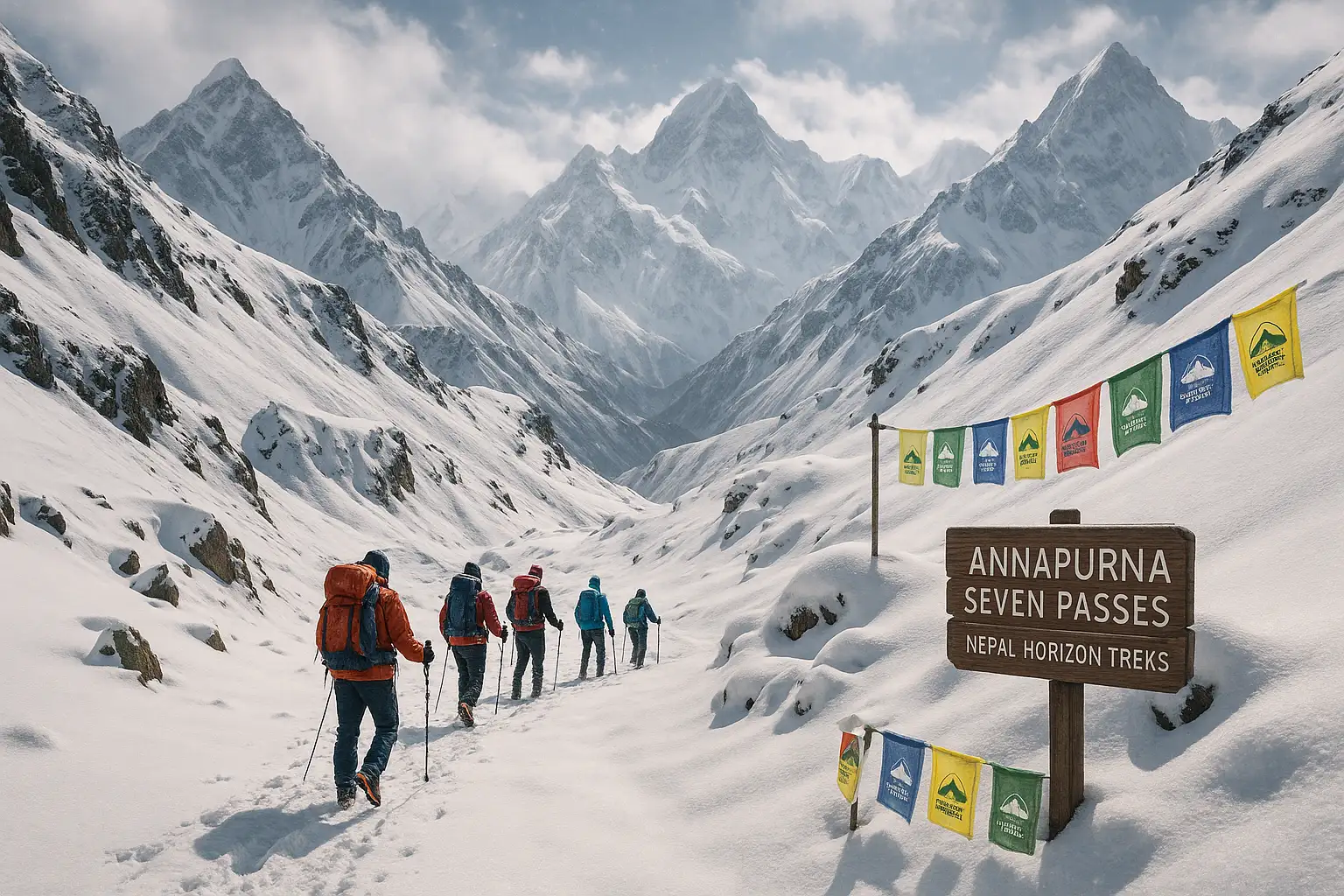 Here’s a closer look at the seven spectacular passes that define this epic journey:
Namun La Pass (5,560m)
Namun La Pass is considered one of the most difficult passes along the trek, with remarkable vistas of Lamjung Himal and Annapurna II. It lies on the eastern side of the Annapurna region, connecting it to the central part of Manang. The elevation relief is quite vertical, lacking cover, and remains snowbound most days of the year, requiring attuned training and savvy altitudinal acclimatization.
Timang Pass (4,600m)
Timang Pass, part of Nar Phu, lies between Kori and Nar Phu. This lesser-known valley is serene and picturesque, along with being a wild and stunning route offering breathtaking views of the Himalayas. The required route is pretty untouched and isolated, hence adventurers are free to fully explore the untamed alpine domain.
Kori Pass (4,500m)
Kori Pass falls between Sikles and the upper Nasa Valley. It is serene and grassy, and has tranquil highland routes. In addition, there is lush greenery, yak herds as well as wildflowers blooming during summer. This provides the region with peaceful solitude while providing stunning vistas of Lamjung Himal and Annapurna II.
Meta Pass (4,650m)
Along with ranking as one of the most ethnically unimpaired areas of Nepal, this pass allows you to venture into the mystical Nar Phu Valley. There is an ancient Tibetan Buddhist civilization that comprises stone stupas, prayer flags, and cliffs with passes that you enter in order to cross Meta Pass.
Phu Pass (5,050m)
Phu Pass connects Meta to Phu Gaon, a historical village located in the lofty heights of the Himalayas. This pass reveals views of the Himlung Himal range and exposes trekkers to life in one of Nepal’s most remote and isolated settlements.
Nar Pass (5,320m)
Crossing Nar Pass takes you from Phu to Nar village, which takes you through high-altitude plateaus and narrow gorges. The trail is adorned with Tibetan Buddhist chortens, stone walls, and herds of yak, bestowing the whole region with a mystical ambiance. The captivating panoramic view also features Kanguru Himal as well as the north face of Pisang Peak.
Kang La Pass (5,320m)
Kang La Pass Interconnecting the Nar Valley and the famous Annapurna Circuit trail lies one of the last and most remarkable passes of this trek. From the top, trekkers are spoiled with jaw-dropping views of Annapurna II, Gangapurna, Tilicho Peak, and many other towering snow-capped mountains.
Why Choose Nepal Horizon Treks for Annapurna Seven Passes Trek
- Nepal Horizon Treks is a trusted trekking company in Nepal specializing in off-the-beaten-path adventures like the Annapurna Seven Passes Trek.
- Our government-licensed local guides have years of experience leading high-altitude treks in the Annapurna region, ensuring expert navigation and safety.
- We provide fully customizable Annapurna Seven Passes Trek itineraries with proper acclimatization to reduce the risk of altitude sickness.
- For remote areas with no teahouses, we offer high-quality camping gear, experienced porters, and full logistical support to keep you safe and comfortable.
- Nepal Horizon Treks handles all trekking permits, including ACAP, TIMS, and Nar-Phu Restricted Area Permits, making your trip hassle-free.
- We offer transparent pricing for the Annapurna Seven Passes Trek with no hidden charges and excellent value for money.
- Your safety is our top priority, with daily health monitoring, emergency backup plans, and 24/7 support throughout the trek.
- As an eco-conscious trekking company in Nepal, we follow sustainable tourism practices and support local communities in the Himalayan region.
- Our excellent reviews and client testimonials reflect our dedication to delivering unforgettable trekking experiences in Nepal.
How to prepare for the Annapurna Seven Passes Trek
Physical Preparation: Train Like a Trekker
This is not your typical teahouse trek. You’ll be trekking for 18–24 days, crossing multiple passes above 5,000 meters. That means stamina, strength, and endurance are essential.
- Cardio Training: Jog, hike, swim, or cycle at least 4–5 times per week to boost your lung capacity and stamina.
- Strength Workouts: Focus on leg and core muscles. Incorporate squats, lunges, step-ups, and deadlifts.
- Backpack Hikes: Do regular hikes with a 10–12 kg backpack to simulate real trekking days.
- Stair Climbing: Mimics steep Himalayan ascents — add weight for extra challenge.
- Flexibility and Mobility: Yoga and stretching prevent injuries and help muscle recovery.
Altitude Acclimatization: Prepare for the Thin Air
You’ll be spending days above 4,000 meters, and crossing passes above 5,500 meters like Namun La and Kang La. That means altitude sickness is a real risk if you're not careful. Here’s how to prepare:
- Understand AMS: Learn to recognize symptoms of Acute Mountain Sickness and how to respond.
- Plan Acclimatization Days: Your itinerary should include rest days and gradual altitude gains.
- Hydrate & Breathe: Drink 3–4 liters of water daily and practice slow, deep breathing at altitude.
- Trek High, Sleep Low: Helps your body adapt better to elevation changes.
- Practice Hikes: If possible, do a high-altitude hike like Langtang Valley or Mardi Himal before this trek.
Packing Smart: Essential Gear for the Seven Passes
You’ll be trekking through remote terrain, often away from any villages or shops. That means having the right gear is critical, especially for cold nights and technical trails.
Your gear checklist should include:
- Backpack (50–65L) + Daypack (20–25L)
- 4-season sleeping bag (rated to -15°C or colder)
- Waterproof boots (broken-in and sturdy)
- Down jacket, thermal layers, fleece
- Waterproof shell jacket & pants
- Trekking poles (a must for descents)
- Headlamp, gloves, hat, buff
- UV sunglasses & sunscreen
- Water filters or purification tablets
- Basic first-aid kit + altitude medicine (Diamox)
- Snacks, dry fruits, energy bars
- Camping gear, if you’re trekking unsupported
Permits You’ll Need
Because this trek passes through both conservation zones and restricted regions, you’ll need multiple permits:
- ACAP (Annapurna Conservation Area Permit)
- TIMS Card
- Nar Phu Restricted Area Permit
- You can arrange all of these through Nepal Horizon Treks or at tourism offices in Kathmandu or Pokhara. Keep passport-sized photos and a copy of your passport handy.
Guide & Porter: A Must for This Remote Route
The Seven Passes trek is extremely remote and less frequented, and many trails are not well-marked. For safety and navigation, hiring a licensed guide is highly recommended.
A porter can carry your heavier gear, allowing you to trek more comfortably and focus on the experience. Local trekking companies (like us!) can provide experienced, trained staff who know the terrain well.
Food & Hydration Tips
Some parts of this trek will have limited access to teahouses or food supplies, especially between high passes.
- Carry snacks and energy bars to stay fueled throughout the day.
- Purify all drinking water using tablets, filters, or UV sterilizers.
- In camping zones, you’ll need to carry basic cooking equipment or rely on guides/porters who can cook.
Mental Preparation: The Hidden Challenge
- Trekking for nearly 3 weeks in wild, isolated terrain is not just a physical challenge — it’s a mental one too. Be prepared for:
- Long, tough days with no network or contact
- Camping in extreme cold and changing weather
- Occasional uncertainty and discomfort
- Moments of awe, humility, and deep solitude
- Stay flexible, embrace the challenge, and trust your team. The rewards — views of untouched mountains, rare cultural experiences, and personal transformation — are worth every step.
Map Overview of Annapurna Seven Passes Trek
|
Route |
Elevation (m) |
Key Highlights / Passes |
|
Kathmandu → Sikles (Drive) |
2,000 |
Gurung village, scenic drive via Pokhara |
|
Sikles → Tasa |
2,750 |
Forest trail, peaceful campsite |
|
Tasa → Kori |
3,800 |
Yak pastures, Lamjung Himal view |
|
Acclimatization at Kori |
3,800 |
Ridge hikes, rest, and alpine scenery |
|
Kori → Thulek |
4,200 |
Remote valley, glacial terrain |
|
Thulek → Nasa via Namun La |
5,560 / 4,200 |
Namun La Pass, panoramic Himalayan views |
|
Nasa → Timang Valley |
4,600 |
Wilderness ridge walk, raw landscapes |
|
Timang → Meta via Meta Pass |
4,650 |
Meta Pass, entry to Nar Phu Valley |
|
Meta → Phu via Phu Pass |
5,050 / 4,200 |
Phu Pass, Himlung Himal, ancient village |
|
Acclimatization in Phu |
4,200 |
Tashi Monastery, cultural immersion |
|
Phu → Nar via Nar Pass |
5,320 / 4,150 |
Nar Pass, Tibetan culture, views of Kang Guru |
|
Rest in Nar |
4,150 |
Monasteries, local interaction |
|
Nar → Ngawal via Kang La |
5,320 / 3,660 |
Kang La Pass, views of Annapurna & Tilicho |
|
Ngawal → Manang |
3,540 |
Mani walls, acclimatization village |
|
Manang → Khangsar |
3,734 |
Offbeat trail, Tilicho views |
|
Khangsar → Tilicho Base Camp |
4,150 |
Narrow trails, glacier valley |
|
Tilicho Lake → Khangsar (Round trip) |
4,919 / 3,734 |
Tilicho Lake, the highest glacial lake |
|
Khangsar → Yak Kharka |
4,050 |
Pastures, Chulu views, return to the circuit trail |
|
Yak Kharka → Chame |
2,710 |
Descent, forest walk, river crossings |
|
Chame → Kathmandu (Drive via Besisahar) |
1,400 |
Jeep drive, riverside scenery |
|
Final Departure |
— |
Airport transfer, end of trek |
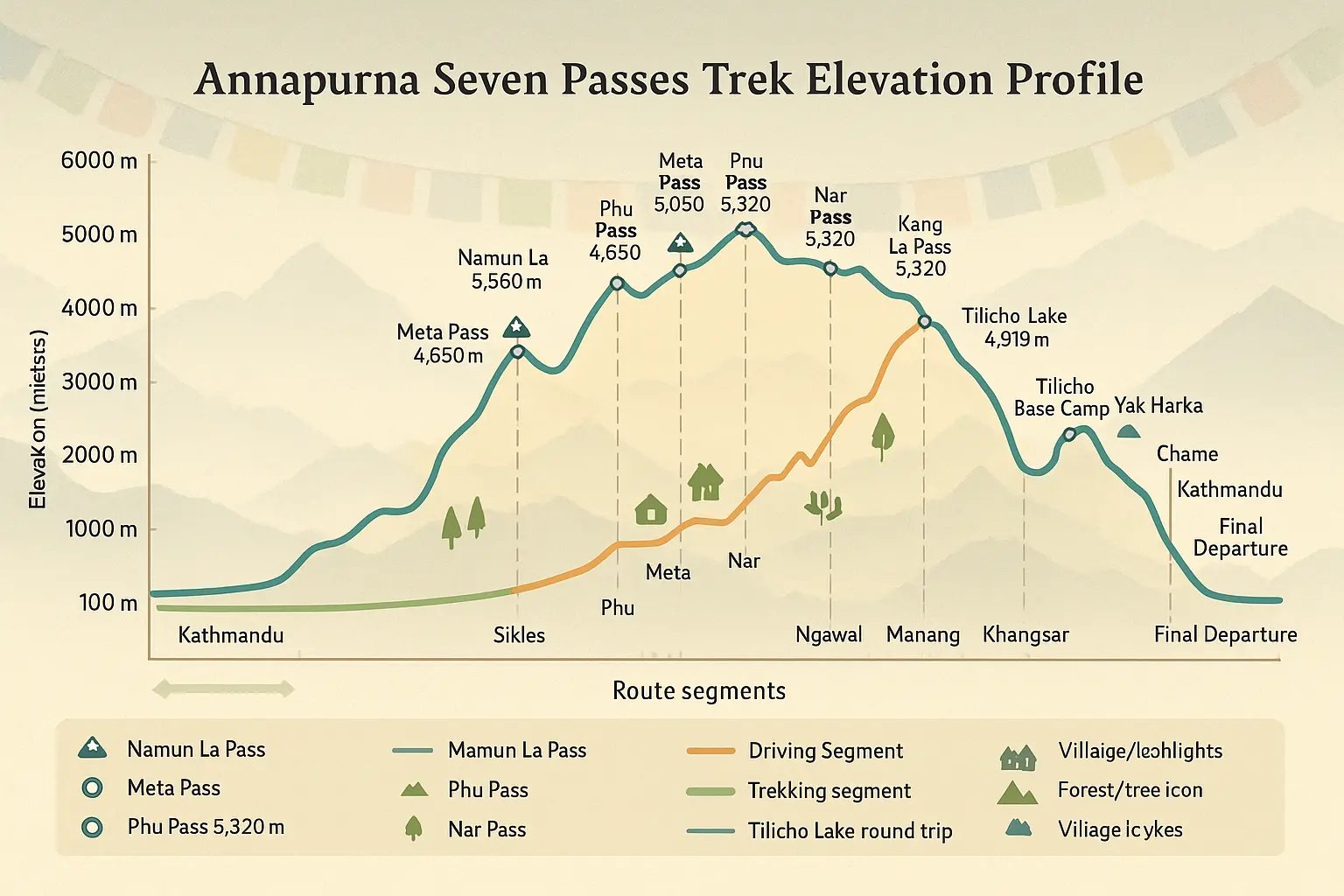
The Annapurna Seven Passes Trek is an exhilarating 21-day high-altitude trekking adventure in Nepal’s Annapurna region, crossing seven challenging Himalayan passes such as Namun La, Meta Pass, Phu Pass, Nar Pass, and Kang La. Starting from the traditional Gurung village of Sikles, this trek takes you through diverse landscapes including lush forests, alpine meadows, glacial valleys, and remote Tibetan-influenced villages like Phu and Nar. Trekkers will explore sacred sites like Tilicho Lake, one of the highest glacial lakes in the world while experiencing authentic Himalayan culture and breathtaking panoramic mountain views. This off-the-beaten-path Annapurna trekking route offers unmatched solitude, rich cultural immersion, and spectacular scenery, making it ideal for seasoned trekkers seeking a unique and challenging Nepal trekking experience.
Annapurna Seven Passes Trek 21 Days Itinerary Overview
|
Day |
Route & Activity |
Highlights / Details |
Overnight |
|
Day 1 |
Drive from Kathmandu to Sikles (2,000m) |
Scenic drive via Pokhara, traditional Gurung village |
Lodge in Sikles |
|
Day 2 |
Trek to Tasa (2,750m) |
Forested trails, terraced fields, peaceful campsites |
Camping |
|
Day 3 |
Trek to Kori (3,800m) |
Alpine meadows, Lamjung Himal views, yak pastures |
Camping |
|
Day 4 |
Acclimatization at Kori |
Explore Kori Ridge, panoramic views, rest day |
Camping |
|
Day 5 |
Trek to Thulek (4,200m) |
Remote trails, wilderness trekking |
Camping |
|
Day 6 |
Cross Namun La Pass (5,560m) – Trek to Nasa Valley (4,200m) |
One of the highest passes, stunning Annapurna views |
Camping |
|
Day 7 |
Trek to Timang Valley (4,600m) |
Isolated ridgelines, wild Himalayan terrain |
Camping |
|
Day 8 |
Trek to Meta via Meta Pass (4,650m) |
Enter Nar Phu Valley, dramatic landscapes |
Lodge in Meta |
|
Day 9 |
Trek to Phu Village (4,200m) via Phu Pass (5,050m) |
Cliffside trails, Himlung Himal views, stone village |
Lodge in Phu |
|
Day 10 |
Acclimatization and exploration in Phu |
Visit Tashi Monastery, explore ancient village life |
Lodge in Phu |
|
Day 11 |
Trek to Nar Village (4,150m) via Nar Pass (5,320m) |
Remote canyon, Buddhist landmarks, Tibetan culture |
Lodge in Nar |
|
Day 12 |
Rest and Cultural Day in Nar |
Explore gompas, meet locals, recharge energy |
Lodge in Nar |
|
Day 13 |
Cross Kang La Pass (5,320m) – Trek to Ngawal (3,660m) |
Epic Annapurna views, long descent to the Manang region |
Lodge in Ngawal |
|
Day 14 |
Trek to Manang (3,540m) |
Easy hike, join Annapurna Circuit, comforts return |
Lodge in Manang |
|
Day 15 |
Trek to Khangsar (3,734m) |
The off-beat route toward the Tilicho region |
Lodge in Khangsar |
|
Day 16 |
Trek to Tilicho Base Camp (4,150m) |
Barren Valley, approaches the world’s highest lake |
Lodge in Base Camp |
|
Day 17 |
Visit Tilicho Lake (4,919m) – Return to Khangsar |
Stunning high-altitude lake, challenging terrain |
Lodge in Khangsar |
|
Day 18 |
Trek to Yak Kharka (4,050m) |
Gradual climb, great views of Chulu peaks |
Lodge in Yak Kharka |
|
Day 19 |
Trek to Chame (2,710m) |
Descend through the alpine and pine forest |
Lodge in Chame |
|
Day 20 |
Drive from Chame to Kathmandu |
Scenic jeep ride via Besisahar and Prithvi Highway |
Hotel in Kathmandu |
|
Day 21 |
Final Departure |
Transfer to Tribhuvan International Airport |
– |